
ALL POSTS
How Seam Placement and Stitching Methods Affect Mascot Costume Durability
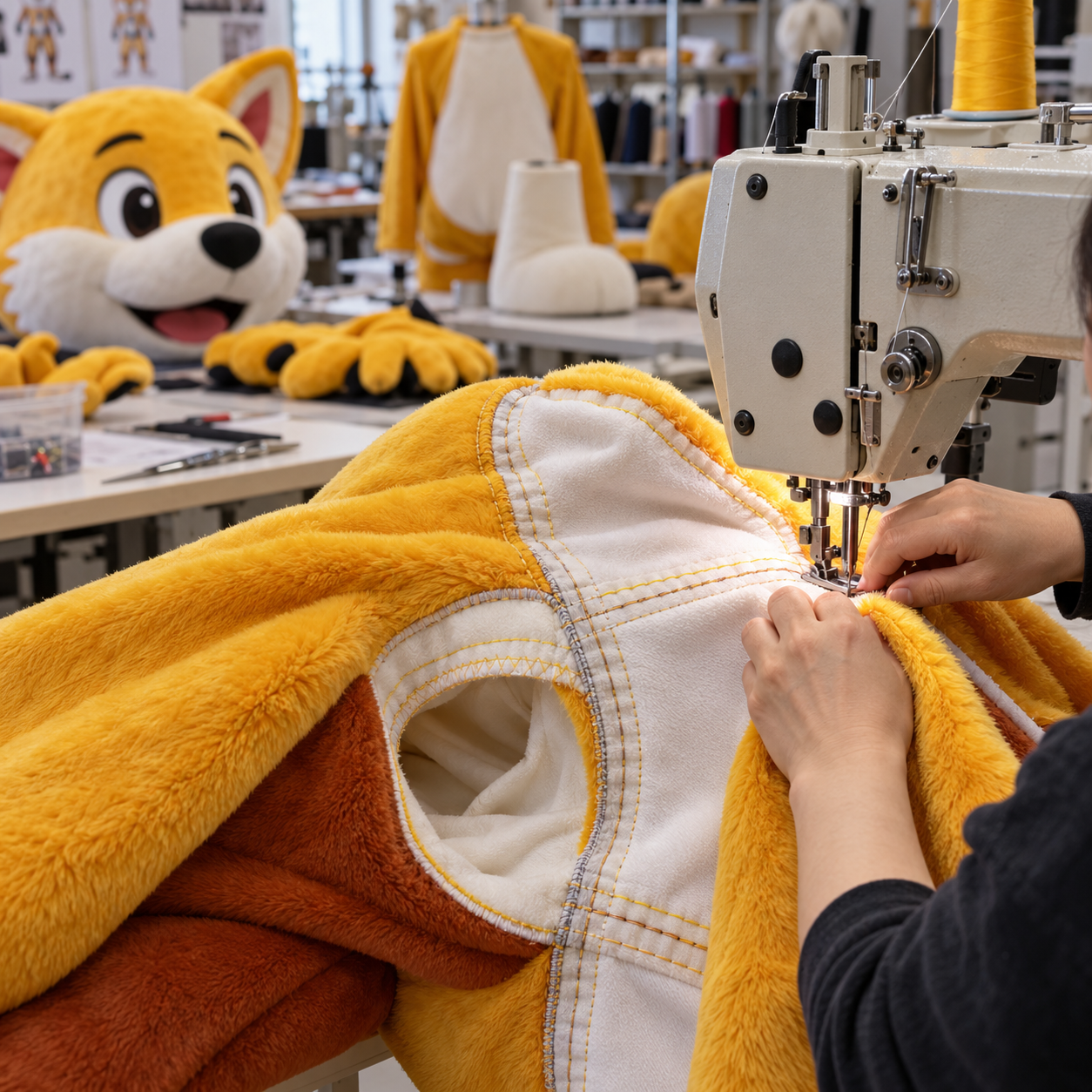
A mascot costume may look simple from the outside, but every panel, seam, and stitch plays an important role in how long the costume can be used.
During performances, mascot costumes are constantly exposed to pulling, bending, stretching, friction, and repeated movement. If seams are placed in high-stress areas or stitched incorrectly, the costume may begin to split, deform, or lose its shape over time.
Good seam design is therefore not only about appearance. It is also an important part of structural durability.
Why Seam Placement Matters
Every mascot costume is made from multiple fabric panels joined together.
Where those panels meet can directly affect the strength of the finished costume.
Areas such as shoulders, underarms, crotches, knees, elbows, neck openings, and shoe connections usually experience more movement and tension than other parts of the costume.
If a major seam is placed directly across one of these stress points, it may be pulled repeatedly during walking, dancing, bending, or performing.
Over time, this can weaken the stitching.
A better design places seams where they can follow the natural shape and movement of the costume while reducing unnecessary tension.
High-Stress Areas Need Stronger Construction
Some areas of a mascot costume naturally experience more force.
Common high-stress points include:
- Underarms
- Shoulder connections
- Crotch areas
- Knee and elbow zones
- Neck openings
- Zipper areas
- Tail attachment points
- Shoe and leg connections
These areas may require additional stitching, reinforced fabric, binding tape, or internal support.
For example, a tail attached only to the outer fabric may eventually pull the fabric out of shape.
A stronger construction connects the tail to an internal reinforcement layer so the load is distributed across a larger area.
Straight Stitching vs. Reinforced Stitching
Different parts of a mascot costume may require different stitching methods.
A basic straight stitch can be suitable for low-stress areas, but high-movement areas often need stronger reinforcement.
Common methods may include:
Double Stitching
Two lines of stitching provide additional strength and reduce the chance of a seam opening if one line becomes damaged.
Zigzag Stitching
Zigzag stitching can allow slightly more flexibility and is useful for fabrics that stretch or move.
Overlock Stitching
Overlock stitching helps prevent fabric edges from fraying and gives the inside of the costume a cleaner finish.
Reinforcement Stitching
Extra passes of stitching may be added around attachment points, zippers, openings, and other areas that experience frequent pulling.
The goal is not simply to use more thread.
The goal is to use the right stitching method in the right location.
Fabric Type Affects Seam Design
Different materials behave differently when they are sewn.
Plush fabrics, stretch fabrics, mesh fabrics, lining materials, and synthetic textiles all respond differently to tension.
For example, thick plush fabric may hide seams visually, but it can also become bulky when several layers overlap.
Stretch fabric may require stitching that can move with the material.
Thin lining materials may need reinforcement to prevent tearing around openings or fasteners.
Understanding the fabric is therefore important when deciding how a seam should be constructed.
Seam Direction Can Affect Appearance
Seam placement also affects how smooth the finished costume looks.
Poorly positioned seams may create visible ridges, wrinkles, or uneven curves.
This is especially important on large mascot heads, rounded torsos, cheeks, stomach areas, and oversized limbs.
Well-planned panel shapes allow the fabric to follow the underlying foam or structure more naturally.
As a result, the costume looks cleaner while also reducing unnecessary tension on the fabric.
Curved Areas Require Careful Patterning
Mascot costumes often contain many rounded or exaggerated shapes.
These may include large heads, noses, cheeks, stomachs, hands, feet, and tails.
Trying to force a flat fabric panel around a complex curve can create pulling and distortion.
Instead, multiple shaped panels may be used to form the curve gradually.
This helps distribute tension and can improve both appearance and durability.
Zippers and Openings Need Reinforcement
Zippers are one of the most frequently used parts of a mascot costume.
Every time the performer enters or exits the costume, the zipper area experiences pulling.
If the surrounding fabric is not reinforced, the zipper may begin to separate from the costume.
Good construction may include:
- Reinforced zipper tape
- Extra stitching at the top and bottom
- Strong backing material
- Protected seam edges
- Proper zipper placement
The opening should also be large enough for practical use.
If the opening is too small, performers may pull excessively on the zipper and surrounding fabric.
Internal Seams Should Be Comfortable
Durability is important, but internal seams should also be comfortable for the performer.
Large seam allowances, rough edges, thick fabric overlaps, or exposed thread can create pressure points.
These areas may rub against clothing or the performer during movement.
Using lining, binding, soft seam finishing, or carefully trimmed seam allowances can improve comfort while maintaining strength.
Stitch Density Matters
More stitches do not always mean a stronger seam.
If stitches are too close together, they can create many small holes in the fabric and weaken the material.
If stitches are too far apart, the seam may not hold securely.
Proper stitch density depends on the fabric thickness, flexibility, and expected load.
This is one reason professional sewing techniques matter in mascot production.
Repairability Should Be Considered
Even well-made mascot costumes may eventually need maintenance.
Seams are often easier to repair than damaged foam structures or heavily glued components.
Designing seams with repair access in mind can make future maintenance easier.
For example, removable linings, accessible internal seams, and replaceable panels can reduce repair time.
This is especially useful for costumes used frequently by schools, sports teams, attractions, rental companies, and event businesses.
Regular Inspection Helps Prevent Larger Damage
Small seam damage is easier to repair than a complete tear.
After frequent use, costumes should be checked for:
- Loose thread
- Small openings
- Fraying fabric
- Stretched seams
- Loose zipper stitching
- Weak attachment points
Early repairs can prevent these issues from becoming larger structural problems.
Conclusion
Seams are easy to overlook, but they are one of the most important parts of mascot costume construction.
Good seam placement allows the costume to move naturally, maintain its shape, and handle repeated use.
Strong stitching methods, proper reinforcement, suitable fabric handling, and careful pattern design all contribute to long-term durability.
A well-made mascot costume is not only defined by how it looks from the outside.
The quality of the hidden construction is just as important.