
ALL POSTS
How Internal Support Structures Affect Mascot Costume Stability and Wearability
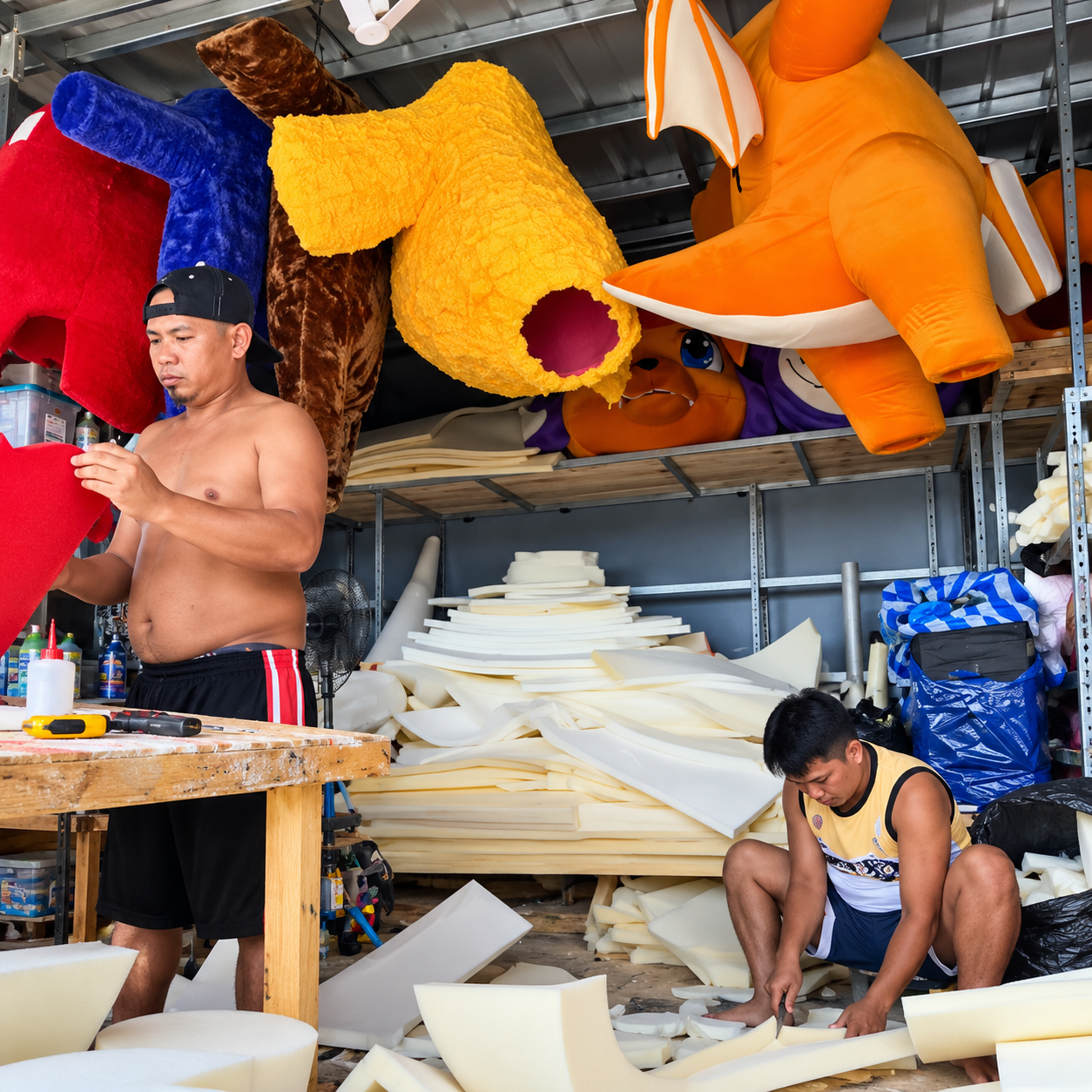
Mascot costumes are often judged by their external appearance, but much of their real performance depends on what cannot be seen from the outside.
Inside a mascot costume, internal support structures help maintain shape, distribute load, reduce unwanted movement, and improve the relationship between the costume and the performer’s body.
These structures can be found in the head, torso, shoulders, hips, feet, and other oversized parts of the costume. Their design has a direct effect on stability, comfort, movement, durability, and long-term usability.
Understanding internal support systems is especially important for mascot costumes that are large, top-heavy, highly sculpted, or designed for repeated professional use.
1. What Are Internal Support Structures?
Internal support structures are the hidden components that help a mascot costume maintain its intended form while being worn.
Depending on the design, they may include:
- foam frameworks
- lightweight plastic supports
- internal harnesses
- shoulder supports
- head suspension systems
- waist belts
- reinforcement panels
- structural ribs
- internal padding
- mounting points
These elements do not usually determine the visual style of the costume directly, but they determine how well that visual form is maintained during movement.
A costume with a strong external shape but weak internal support may look good when placed on a stand but perform poorly when worn.
2. Why Internal Stability Matters
Mascot costumes move differently from ordinary clothing.
Large heads, oversized hands, wide torsos, long tails, and sculpted feet all create additional forces during walking, turning, bending, and performing.
If the internal support system is unstable, several problems can occur:
- the head may shift during movement
- the torso may rotate around the performer
- shoulders may collapse
- oversized parts may bounce excessively
- weight may concentrate on small areas of the body
- the performer may need to constantly correct the costume position
This increases fatigue and reduces control.
A stable internal structure allows the costume to move together with the performer rather than moving independently from them.
3. Head Support Systems
The mascot head is often the largest and most structurally demanding part of the costume.
A head must remain visually aligned while also allowing the performer to:
- see clearly
- breathe comfortably
- turn the head
- maintain balance
- move naturally
Several types of internal head support can be used.
Foam-Fitted Head Support
A shaped foam interior can help the head sit securely around the performer’s head.
Advantages include:
- simple construction
- lightweight design
- close fit
- good stability for smaller heads
However, if the foam is too tight, it may create pressure points or reduce airflow.
If it is too loose, the head may move independently during performance.
Helmet-Style Support
Some mascot heads use an internal helmet or adjustable suspension system.
This allows the outer mascot head to connect more securely to the performer’s head.
Advantages include:
- improved head control
- better load distribution
- reduced internal movement
- adjustable fit
This approach is useful for heavier or larger mascot heads.
Shoulder-Supported Head Systems
Very large mascot heads may be partially supported by the performer’s shoulders rather than entirely by the head and neck.
This reduces neck strain.
However, the structure must still allow enough movement for turning and performing.
4. Shoulder Support and Load Distribution
Shoulders are important load-bearing areas in many mascot costumes.
A poorly designed shoulder structure may cause:
- uneven weight distribution
- neck pressure
- shoulder fatigue
- costume rotation
- restricted arm movement
Internal shoulder pads or support frames can distribute the weight more evenly across a wider area.
The goal is not simply to make the structure rigid.
It should be stable while still allowing natural movement.
A structure that is too stiff can make the costume uncomfortable and mechanical.
A structure that is too flexible may lose shape and stability.
5. Torso Structure and Shape Retention
Mascot torsos often use layered foam or internal support panels to create exaggerated body proportions.
These structures may create:
- large stomachs
- broad chests
- wide shoulders
- narrow waists
- rounded body shapes
The torso must retain its visual shape without interfering with breathing or movement.
One common mistake is using too much structural material.
Excessive foam can increase:
- weight
- heat retention
- stiffness
- drying time
- storage volume
A more efficient design uses support only where it is structurally necessary.
6. Internal Harness Systems
Harness systems are especially useful in large mascot costumes.
A harness connects the costume to the performer at specific points.
Common attachment areas include:
- shoulders
- chest
- waist
- hips
The purpose of the harness is to keep the costume aligned with the performer.
Without a harness, a large costume may rotate, slide, or shift during movement.
A properly designed harness can improve:
- stability
- posture
- weight distribution
- performer control
- movement accuracy
However, the harness must be adjustable.
Different performers may have different shoulder widths, torso lengths, and body proportions.
7. Hip and Waist Support
The waist and hips provide another useful support area.
Waist belts can help stabilize:
- large torsos
- tails
- lower body structures
- padded hips
- wide costumes
A waist support system can reduce the amount of weight carried by the shoulders.
This is especially useful for costumes with large lower-body structures.
The belt should be wide enough to distribute pressure rather than concentrating it in one narrow area.
8. Structural Support in Oversized Feet
Mascot feet are often much larger than normal footwear.
Their internal structure must balance several requirements:
- shape retention
- low weight
- walking stability
- flexibility
- floor contact
- durability
Too much internal structure can make the feet heavy and rigid.
Too little structure can cause them to collapse or twist.
The internal base should help keep the foot aligned with the performer’s real foot.
This reduces the risk of uneven movement.
9. Tail Support and Attachment
Large tails create a different type of structural problem.
A long or heavy tail produces leverage as the performer turns.
If the tail is attached only to the outer fabric, repeated movement may stretch or damage the costume.
A stronger design transfers the load to an internal support point.
Possible attachment methods include:
- waist belts
- reinforced panels
- internal foam bases
- hidden support straps
This prevents the outer fabric from carrying the entire load.
10. The Importance of Controlled Flexibility
A mascot costume should not be completely rigid.
The best internal structures provide controlled flexibility.
This means the costume can move slightly with the performer without losing its intended form.
For example:
- shoulders should move naturally
- the torso should compress slightly when bending
- the head should remain stable without feeling locked
- the feet should flex enough for walking
Controlled flexibility reduces structural stress.
It also makes movement look more natural.
11. Reinforcement at Stress Points
Certain areas experience repeated mechanical stress.
Common stress points include:
- shoulder seams
- head attachment areas
- arm openings
- waist connections
- tail bases
- foot openings
- zipper areas
Internal reinforcement can prevent these areas from stretching or tearing.
Reinforcement materials may include:
- webbing
- reinforced fabric layers
- flexible plastic
- additional foam
- stitching support
The reinforcement should be strong without adding unnecessary bulk.
12. How Poor Internal Support Affects Performance
A mascot costume can look visually impressive while still performing poorly.
Weak internal support may cause:
- unstable head movement
- shifting body shape
- uneven weight
- reduced visibility
- excessive performer fatigue
- awkward movement
- faster material wear
These problems often become more noticeable after extended use.
A costume that is only tested briefly may appear acceptable.
But after 30 or 60 minutes of performance, structural weaknesses can become much more obvious.
13. Internal Structure and Performer Safety
Internal support systems are also important for safety.
A stable structure reduces unexpected movement.
For example, if a mascot head suddenly rotates or tilts during walking, the performer’s vision may become misaligned.
If oversized feet shift internally, walking stability can be reduced.
Proper support helps maintain a predictable relationship between the performer and the costume.
That predictability is important when performing in:
- crowded events
- stadiums
- shopping malls
- outdoor festivals
- schools
- promotional events
14. Designing for Different Performer Sizes
Mascot costumes are often used by more than one performer.
This creates a challenge because body dimensions vary.
Adjustable systems can help accommodate different users.
Useful adjustable features include:
- shoulder straps
- head suspension
- waist belts
- internal padding
- removable foam inserts
The goal is to allow adjustment without making the internal system complicated.
15. Maintenance of Internal Structures
Internal support structures also require maintenance.
Over time, they may experience:
- foam compression
- strap stretching
- fastener wear
- structural deformation
- moisture accumulation
Regular inspection should include:
- attachment points
- harness straps
- internal foam
- support panels
- stitching
- mounting hardware
Small structural problems are easier to repair before they affect the entire costume.
16. Structural Efficiency Matters More Than Maximum Rigidity
A common assumption is that a stronger mascot costume should contain more structural material.
This is not always true.
Good internal engineering uses the minimum amount of material necessary to achieve stability.
This helps reduce:
- weight
- heat
- stiffness
- material cost
- storage difficulty
The goal is structural efficiency, not maximum rigidity.
Conclusion
The internal support system of a mascot costume is one of the most important factors affecting how the costume feels and performs.
A well-designed structure keeps the costume stable, distributes weight, supports large sculpted elements, and allows the performer to move naturally.
Effective internal design requires balance.
The structure must be strong enough to maintain the intended shape, but flexible enough to move with the performer.
It should distribute loads efficiently without adding unnecessary weight.
For this reason, mascot costume engineering should consider not only external appearance, but also the hidden relationship between the costume structure and the performer inside it.